In Part 5, we continue our adventures through Chin State.
Just a few years back, It would have quite remarkable that I was even up there.
Like much of Myanmar, Chin had been closed to foreign tourists for decades. The
few that did make it up there were invariably accompanied by gov’t approved
tour guides on gov’t run travel packages. This little state, landlocked between
India and Myanmar hasn’t had many tourists until recently.
They like to paint their houses in vivid colors
Some facts about Chin State: At about 15,000 square miles,
it’s roughly the size of Switzerland. About 2/3rd the size of West
Virginia and one and half times bigger than Vermont. Whereas 8 million people
live in Switzerland and 2 million reside in West Virginia, the population of
Chin is a bit shy of 500,000. And like these other places, it’s all
mountainous. I can’t say that I saw a single bit of horizontal land in the
whole state that people hadn’t made that way.
Being so sparsely populated, there are only a few real towns
in the state. In this episode, I travel between two of them which aren’t very
far apart: Hakka (the new capital) and Falam (the old capital).
Again, I was
taken in by the amazing mountain views I got to see and noticed a few things.
Chin burial customs involve roads. At almost every major turn in the road, at
almost every spot where you could look out and see spectacular vistas of
expansive mountains and valleys, there were graves.
Not graveyards, just
graves. Two or three, up to eight perhaps if it was remarkably beautiful spot.
And of course, memorials to the dead. Structures to preserve them from the
elements. It was kind of odd that at every point when I wanted to stop and take
a picture of the remarkable landscape, that I was doing so alongside someone’s
dead uncle, but I’m not superstitious in that regard. If there’s
life-after-death, ghosts, that sort of thing, I’d think any human soul would
appreciate what I was doing, and wouldn’t be offended if I needed to go pee on
the periphery of their gravesite.
Breakfast in Hakha
I got to Falam, a very religious town which I’ve heard
recently tried to ban alcohol sales within the town limits.
Having a nose for
these sorts of things, I found that this ban would involve shutting down one
shop, because it seemed there was only one place in town to get a beer.
Once again, I’m doing the thing I enjoy most in the world:
I’m back on a motorcycle tour!As I
write this, I’m sitting in an odd restaurant “night club” in the small Myanmar
town of Palࣰe,
Sagaing Division. I’m starting to write now, long before I expect a video will
be uploaded, because I want to recall details and feelings while they’re still
rather fresh in my mind.
This trip is going to be different in several ways. First of all,
I’m not visiting any of the major tourist destinations in the country. Apart
from Mandalay where I rented the motorbike, I’m not travelling to any cities of
any significant size. This town I’m in right now has only one guesthouse, and
prior to the trip, I wasn’t even sure they’d accept foreigners (not all
accommodations in Myanmar are licensed to do so; they must meet certain
requirements like western style toilets). I couldn’t contact them because other
than appearing on Google maps, they have no presence on the internet. Not even
a phone number!
Secondly, the regions I’ll be visiting are more remote and hard to
get to. If you’ve followed previous journeys, you might remember from the
“Epic” of February 2017 that I changed my plans and gave up on heading further
into Myanmar’s westernmost state, Chin, after a bone-jarring ride in the
initial leg. My little Chinese scooter couldn’t handle it. Well, this time,
I’ve rented a Honda CRF250, a hardy bike that can handle pretty much anything,
and this time, I’ll conquer Chin.
After Chin State, I’ll be following the Chindwin River upstream to
get as close as I can to the mysterious-sounding Nagaland.The Naga people
are well known for being little known.I
don’t want to go to Nagaland proper because there’s nowhere to go from there
except into India (can’t do that on a Myanamar motorbike) or back the way you
came. I’m not a fan of that.
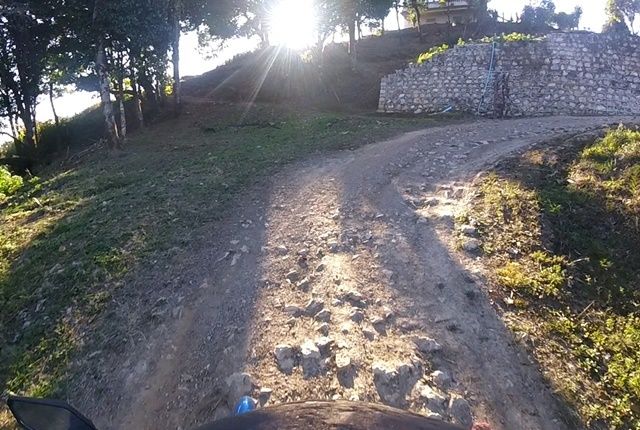
When you reach a fork in an unmapped road, you need to look
for clues. For example, in this pic, the road on the loft is
more traveled.
Lastly, this journey will be different in that I’m going to be
driving on roads that only appear on some maps. Google maps won’t help me because
these roads aren’t on it. On Google
Earth, however, zooming in, you can see them on the satellite image.I just need to be careful I don’t mistake a
river for a road again.
In the initial video, I start off in Yangon, on the morning of
last day of work, drop Badger off at the cat-sitter I’ve employed and make a
mad dash to the Yangon bus station situated way out on the outskirts of
town.As traffic can turn into gridlock
at any time here, I was quite nervous that maybe I had not allotted myself enough
time. I made it with 30 minutes to spare, but in my rush I had forgotten
several key items: my map of Myanmar, the fancy motorcycle-riding jacket I’d
been given (It had pads and armor built in) and worst of all, the carefully
prepared itinerary that one of my Myanmar colleagues had made for me, well
outside her regular duties. It had hotel names, phone numbers and prices. Shit!
Map of DayOne
To top it all off, I had spent extra on my ticket for a “VIP” bus,
a first-class bus that instead of the normal, confined, four seats per aisle,
this one only was supposed to only have three. I was actually looking forward
to the nine-hour luxurious ride from Yangon to Mandalay. What I got was a
standard bus. Somehow, the booking agency had messed up my ticket. I booked it
online and so there was little I could do at that point.
Once in Mandalay, I got to meet someone I’ve known online for
years, Zach, the owner of Mandalay Motorbike and tours. Visit:
mandalaymotorbike.com!Zach has given me
tons of advice over the years on my Myanmar motorcycle journeys, and in turn,
I’ve sent him referrals whenever I can. Plus, he watches and likes my videos.
Zach has my dream job. He actually makes his living spendingweeks on the road, exploring new places,
interacting with the wonderful people here in this exotic country. We spent a
few hours swapping stories, he sharing his insights and knowledge on my
proposed route.
CRF250
Then, it was off to Sagaing.Sagaing is the capital of the province of the same name, and it’s
relatively close to Mandalay, just a 45 minute drive or so. From there, I
happened onto Sagaing Hill and its famous concentration of temples (some call
them “pagodas”, but I’ve never been fond of that word as it reminds me more of
China and Japan – the word ‘pagoda’ is nothing more than the Portuguese word
for temple). Wow! What a sight!
Lastly, up to the famous antiquities of Mingun (Min Kun). There, I
saw a lot of foreign tourists; the last I expect to see in any number for the
rest of the way. Mingun is home to the largest temple I’ve seen here outside of
Bagan. Construction began in the late 18th century, but due to historical
inconveniences like massive earthquakes and the invasion of the British, it was
never completed.
From Sagaing Hill overlooking the mighty Ayeyarwaddy River
All in all, I’m ecstatic to begin this trip. As it has its unique
aspects, there will undoubtedly be unique challenges. With this awesome machine
under me, I have little doubt I’ll overcome them as I have before.
Enjoy the first video!
Technical note: I use two cameras on these journeys now. My GoPro
mounts onto the helm and is also useful for recording people candidly without
them realizing they’re on camera. My other camera I use for buildings and
scenery and such. Anyways, the GoPro and my video software are having a hard
time communicating in regards to format. The GoPro footage shows up in a 4:3
ratio, creating a vertical “letterbox” effect.
I said goodbye to the nice manager and staff of the Pyi Shwe Theinga Hotel and headed into the heart of Shwebo, the old royal palace. As I mentioned in the last blog, Shwebo was one of many former capitals of Myanmar (Burma). How and why it came to be so, I didn't know. I learned there at palace which king made Shwebo so important: none other than U Aung Zeya. I had read of this man. During a time when Burma was split up into several small minor kingdoms (Ava, Pyay, Bago),
constant conflict existed between the different ethnic groups (Bamar, Mon, Shan), and the country was constantly being raided by the surrounding countries (Manipur in India, Yunnan in China and Thailand), from a humble village of a few thousand, U Aung Zeya secured the allegiance of the surrounding villages and fortified Shwebo. Over time, the people recognized him as the kind of strong, scrupulous, fair leader they needed as king, and thousands flocked to his banner. He deposed the other minor kingdoms, conquered the country, including a town called Dagon, renaming it Yangon, meaning 'end of strife' (where I live today) and founded what has come to be known as the Third Burmese Empire. Remarkable king, and learning all this historical stuff really gave context to what I was seeing.
I was quite pleased to spot on the Google maps an alternate route to Mandalay, as the most direct route would mean going back down roads I had already come up. I hate doing that. Better still, the easterly route took me into hills and forests. Indeed, as I drove through it, considering how close it was to a big city like Mandalay, it was mostly wilderness. Perhaps this explains this sign which I saw at both of my rest stops along the way.
Eventually, I got to Mandalay! I found a hotel, and went to visit a famous Mahamuni Pagoda. There, I bought some gold leaf intending to apply it onto a Buddha image as an offering.
The gold cost all of $1.50, so as you might imagine, it was quite thin and wispy. Hard to manage. I'm pretty sure I ended up applying more of the gold onto my own fingers than onto the revered Buddha. Knowing that I was going to spend a couple days in Mandalay, I wasn't in any rush see it's many attractions. But I thought sunset at the royal palace might be nice to see. Thing is, the royal palace is inside the moat-surrounded inner city which only had a couple of gates. Also, the inner city is mostly just a military base with very restricted access. Turned out not only had I arrived at the wrong gate for foreigners to pass through...
...but I had also arrived too late. No tourists allowed to enter after 5:30 PM. The soldiers were nice enough, advising me to return tomorrow and at which gate.
Christmas 2015 was rare in that it landed on a full moon. Well, at
least that's what I thought as I stared into the clear skies of the
Shan Hills. Sure looked like a fool moon. I imagine it's hard to
pinpoint exactly which day the full moon falls. I mean, at the
moment, it's one day here, but on the other side of the planet, it's
still yesterday. There's probably some council of astronomers
somewhere who make this decision.
The term "towel head" is a racial slur, but not against these
Shan women who literally wear towels on their heads.
So, actually, the full moon was on the 26th. As full
moons are always holidays in Theraveda Buddhism, and the one for this
month particularly so, I saw lots of celebrations and ceremonies on
the roads of Myanmar as I made my way from Inle Lake to Pinlaung.
At the end of the video for Part 5 of this series, I ended it by
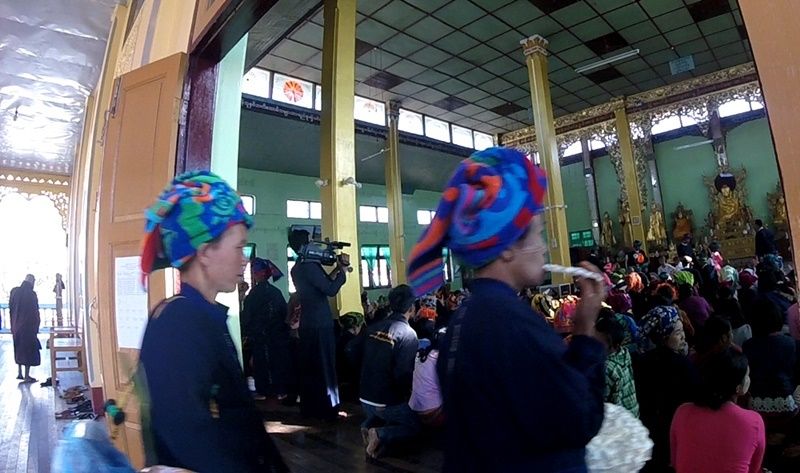
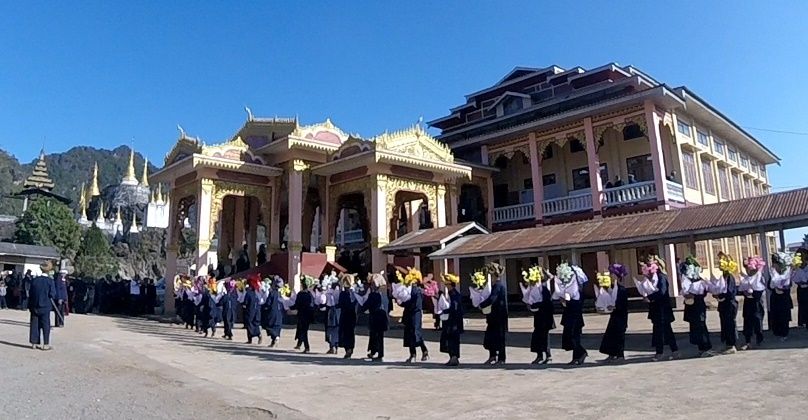
showing a remarkable procession playing haunting, mystical music.
What was the procession for? You'll see in the video.
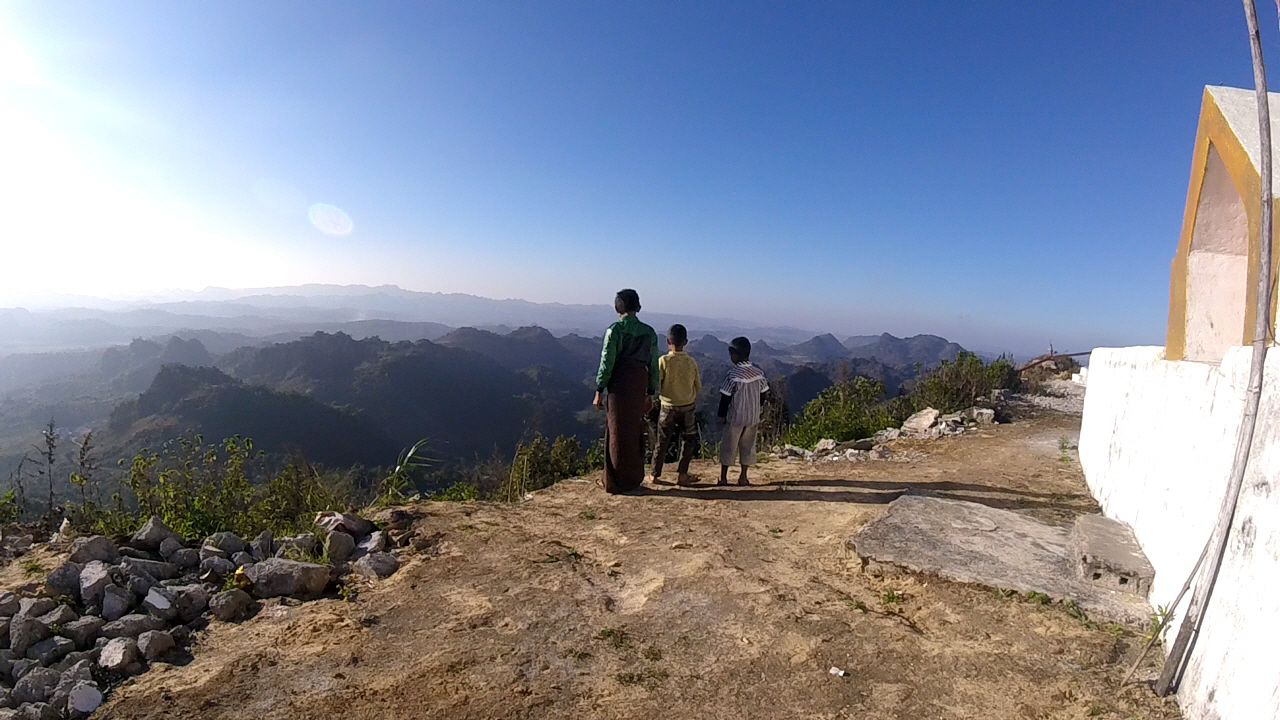
The best reason to visit Pinlaung is to go up to Loi Maung Taung
Pagoda. The view from up there, wow, even the locals who go there
every day to pray are amazed by the vistas.
Local kids are just as impressed as anyone
Near the top, the road becomes bad, but it so worth it.
Another thing I did in Pinlaung is gather information. See, one of
the scary parts about going there is that there was absolutely no
tourist information about the place online whatsoever. No page in any
travel guide. No reviews of any sort. My friend had told me there was
a hotel, and as you saw, I found it just fine. One thing I am going
to do now, however, is to create a Wikitravel (the travelers version
of Wikipedia) page for the place. I found out about buses, trips up
to the pagodas, I can review two restaurants there and as you'll see
late in the video, I stopped at the other hotel in town to inquire
about rates. I think of it as doing my good deed for the internet.
Enjoy the video (have you noticed a theme in regards to the music?)
My president visited Yangon today. I knew it was happening. I had
no idea what his itinerary was, but since I had plans today that
involved riding way out to the outskirts of town, my biggest concern
was that the various motorcades (the Chinese and Japanese heads of
state are also here today, and traffic on any normal afternoon is
horrible enough on it its) might get in the way of the important
thing I was planning. Now, I'm wiping small tears from eyes as I've
finished watching Barack Obama deliver a speech to and answer
questions from a group of young people here in Yangon. Was Obama's speech particularly
moving? Well, no, not really. His
message was more about the challenges facing the region of Southeast
Asia as a whole and how the USA was hoping to help with that rather
than anything specific to Myanmar.
During the speech, Obama seemed tired. Of course he was. It was 4
AM Washington DC time. He'd woke up this morning in Beijing, and had
already had an earlier meeting today and long talk with the Nobel
lauraete Aung Sang Suu Kyii. I called him 'my president'; I voted
for him twice. Six years is a long time on his job, and I could see
the weariness in his eyes. He didn't look like that when I left
America in 2013. Travel, the mid-terms and just the grind of the
being the 'leader of the free world' takes a toll on a guy.
There was an extensive question and answer session following his
speech at this ASEAN Youth Summit, and the crowd really loved having
him there. They do love Obama here. Today was his second visit to
Myanmar. His first, just two years ago, was the first time any
American president had visited this country.
I knew I'd be able to catch the coverage of the visit as I rolled
home via taxi from the aforementioned important thing I had to do
today. See, even though it was just before 4 in the afternoon, there
were already large crowds at the ubiqutous Yangon roadside teashops,
all watching the TV screens just as they do when an important soccer
match is being shown. I wondered what they were watching and craned
my neck to get a view. I saw pictures of Air Force One landing. I
stopped at one of my regular Mom & Pop shops on my way home. The
shopkeeper asked me if I had joined the crowds on the nearby central
road which had been the path the Obama motorcade. I hadn't, but if I
had known... All these clues added up to me knowing I could see more
on my TV when I got home, and perhaps witness my president during his
visit to my current town.
This country faces some extremely difficult and long-lasting
issues. Myanmar has had 65 years of non-stop civil war. It's the
longest ongoing armed conflict in the world, and the struggle these
last few years is to get a lasting cease-fire, much less any actual
true peace settlement. In brief, Myanmar is country of dozens of
ethnicities; if you're on one side of the dispute, you'd call them
'nationalities'. For decades, armies of the ethnic groups have
resisted and fought the central power, mostly comprised of people of
the dominant Bamar (from which Burma gets its name) people. Not only
has their been civil war, there's also devastating poverty (Myanmar
is Asia's second-poorest country), natural disasters, corruption,
oppression of civil rights and freedom of speech. Yeah, Myanmar is a
real maelstrom of issues.
You can't expect the president of the USA to be an expert on
everything, and the young people at the Q&A session were asking
really tough questions on specific issues would have been difficult
for a Myanmar expert to answer. Still, he asked for it, and I guess
he is probably used to answering questions internationally on
domestic issues that really have nothing to do with USA . So, I
suppose I can excuse my president for not answering the crowd's
questions as eloquently and completely as I was answering for him in
my head.
For example, the first question asked of him was from a young man
from Rakhine State who asked how he could foster greater tolerance
from his fellow (Buddhist) Myanmar youth. He wanted advice as to how
to influence his friends and neighborrs. The subtext here has to do
with the almost institutional hatred some Rakhine people (and the
state gov't) have for a certain minority there who call themselves
the Rohingya people. The gov't here won't even acknowledge the name
Rohingya, instead insisting on calling them Bengali, and insisting
they are illegal immigrants. This minority has been the object of
infamous discrimination and oppression. That they are Muslims makes
this easier to accept for the Myanmar, 90% of whom are Buddhist.
Obama's answer started well. He mentioned that no country can ever be
successful if it is divided against itself. I thought he was going
to advise appealing to these folk's own nationalism and
self-interest; tell your friends Myanmar will never join the ranks of
developed nations if they can't accept and tolerate marginally
external ethnicities. Instead, he obfuscated for a while, and then
told the guy that anytime one of his friends said something racist,
he shouldn't just sit back and listen. He should step up and say that
no, racist hate speech is wrong.
Umm, okay, sort of a passive anti-intolerance approach. Wait for
it happen, then react. I've heard this same tactic for promoting
pluralism advocated by other diversity 'experts' in the USA. It may
even be the right approach for the USA. But on Myanmar's west coast,
where thousands of Rohingya live on eggshells in fear of pogroms and
the majority's hatred, I think a more proactive approach to promoting
religious and ethnic tolerance is called for. For example, just
today, the governor of Rakhine attacked the SecGen of the United
Nations for even using the word 'Rohingya' in comments the SecGen had
made earlier week. Oh, c'mon. The situation in Rakhine State is more
serious than perhaps Obama is aware (or was made aware of by his
aides), and his advice was stupid and inadequate.
My next criticism of Obama is really a matter of basic 'cultural
awareness 101'. Perhaps, on a more meta level, even just 'being
nice 101'. A young lady in the crowd stood up to ask her question,
and reading from her notes held in trembling, nervous hands, started
to ask my president, “Good morning, Mister President, my question
today is...” At which point Obama interrupted her with
”WELL, IT'S AFTERNOON...”. The young lady immediately lost face
and was made to look stupid for not having perfect command of
greetings in the English language. Yes, it was 4:30 PM, and Obama's
quip immediately got a little round of guffaws from the crowd, most
of whom were probably feeling what I was feeling and certainly anyone
from Asia was squirming in discomfort. Why did he humiliate that poor
young woman so? Why did he point out her little error when he didn't
need to? Um, English isn't the first language of Myanmar. People here
on this entire continent have a much greater sense of public
humiliation; even as an English teacher, you have to excuse little
mistakes in speech and not jump on them like that, particularly when
the whole world is watching. I was more embarrassed for my president
for acting so uncouth than I felt embarrassed for the young lady.
C'mon, Obama. Asian discourse 101. That said, that young woman
will probably remember that moment as both her proudest (being able
to ask the POTUS a question), and most humiliating moment of her
life.
When the Q&A's were over (you can see the whole thing on
YouTube here), Obama, tired and worn out after crossing the Pacific
and participating in innumerable summits and talks, and getting ready
for this evening's flight to Australia, spent a good 20 minutes
wandering around the crowd shaking hands and conversing individually.
I only know this because Myanmar TV captured every second of every
minute Obama was to be seen. Now, if this were a campaign event and
Obama was out to court votes and enthusiasm, I'd understand it, but
this wasn't. He was in Burma, fer crissakes. Still, he shook
everyone's hands. He let himself be part of dozens of selfies with
significant background.
No, my president wasn't perfect on his visit to Myanmar, but he
was who he was. I still like the guy.
Now, what about that important thing I was doing today? That'll have to wait until the next blog.
Instead, as usual, I'm gonna conclude with a video of me playing the ukulele.